How Multi-Agent Systems Coordinate Complex Work The Architecture Behind Collaborative AI Systems
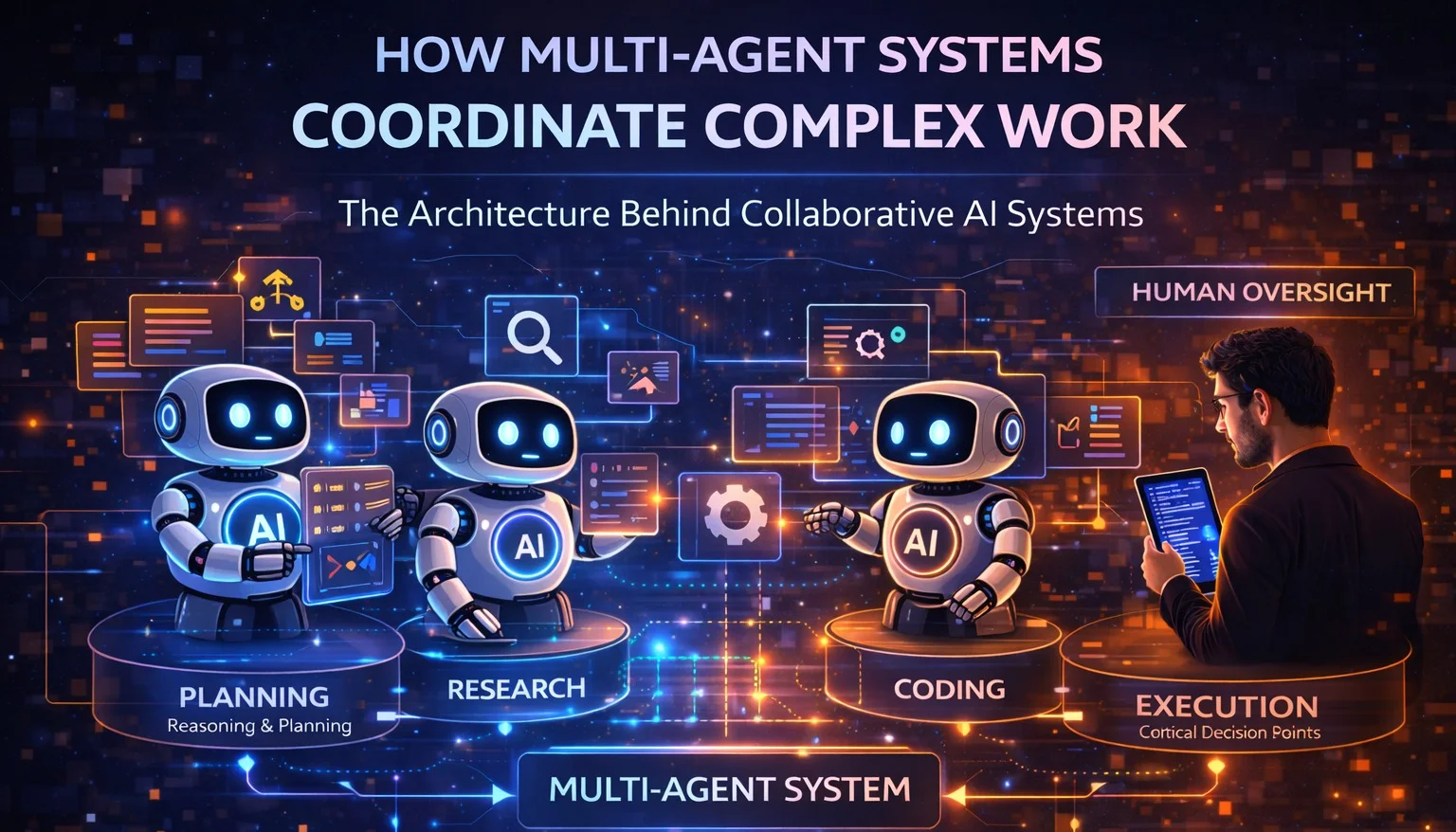
As AI systems become more capable, a single model is often insufficient to manage complex workflows. Multi-agent architectures distribute tasks across specialized agents that collaborate to solve problems. These systems enable AI to plan, reason, and execute tasks through coordinated intelligence rather than isolated responses.

The Limits of Single-Agent AI Systems
Early AI applications typically relied on a single model interacting directly with users. The model would receive an input prompt, generate a response, and complete the task within a single reasoning step.
This approach works well for tasks such as answering questions, summarizing documents, or generating small pieces of code. However, as AI systems began handling more complex workflows, the limitations of single-agent architectures became clear.
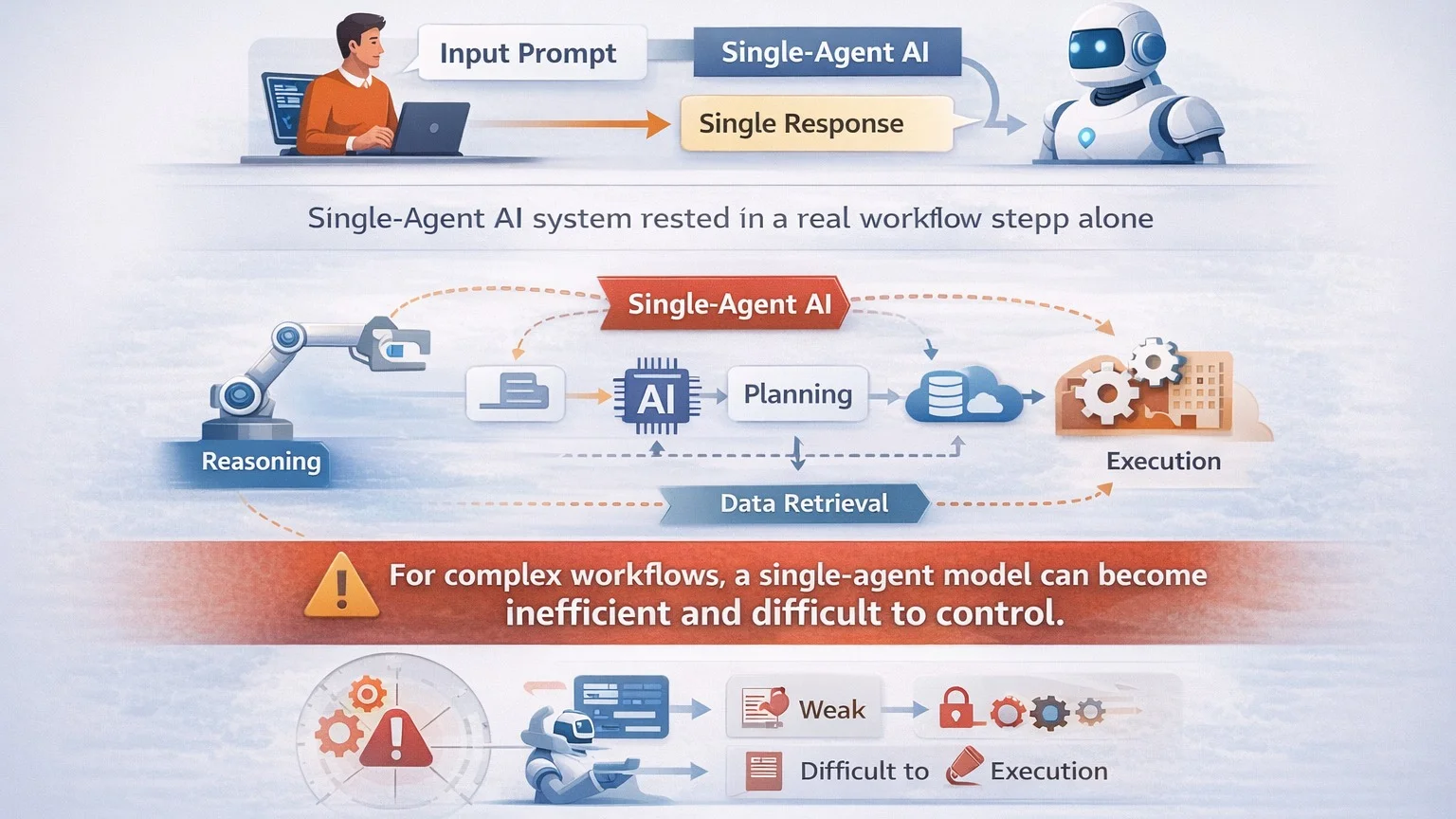
Complex problems often require multiple stages of reasoning, planning, data retrieval, and execution. A single model attempting to handle all of these responsibilities can become inefficient and difficult to control.
Multi-agent systems address this limitation by dividing responsibilities among specialized agents.
Instead of one system attempting to do everything, multiple agents collaborate to complete a workflow.
The Concept of AI Agents
An AI agent can be understood as a system capable of reasoning about tasks, making decisions, and interacting with tools or external systems.
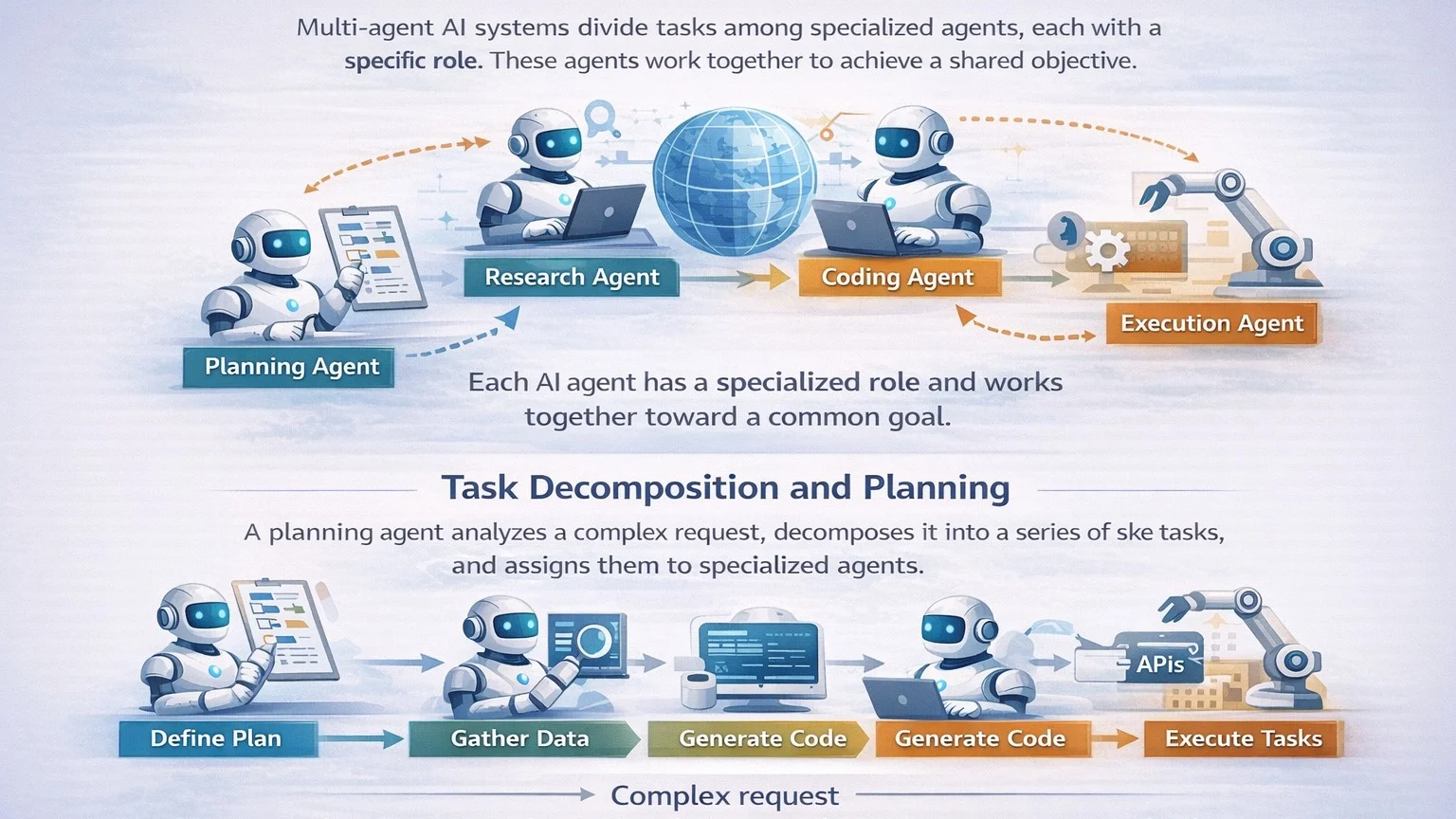
Each agent is typically designed with a specific role. Some agents focus on planning tasks, while others perform research, retrieve data, generate code, or execute operations.
This separation of responsibilities mirrors how human teams operate. In complex projects, individuals rarely perform every task themselves. Work is distributed across team members with specialized expertise.
Multi-agent AI systems apply the same principle to intelligent automation.
Agents communicate with one another, exchange information, and coordinate their actions to complete a shared objective.
Task Decomposition and Planning
One of the primary advantages of multi-agent systems is their ability to break large problems into smaller, manageable tasks.
When a complex request enters the system, a planning agent analyzes the objective and decomposes it into a series of steps. Each step is then assigned to the appropriate agent based on its capabilities.
For example, a workflow may involve several stages:
A planning agent defines the sequence of tasks
A research agent gathers relevant data
A coding agent generates implementation logic
An execution agent interacts with external tools or APIs
By dividing the workflow across specialized agents, the system can operate more efficiently and maintain better control over each stage of execution.
This structure allows AI systems to handle tasks that would be difficult for a single model to manage reliably.
Communication Between Agents
For multi-agent systems to function effectively, agents must share information with one another. Communication is therefore a critical component of the architecture.
Agents typically exchange structured messages that describe task states, intermediate results, and next steps. These messages allow agents to coordinate their actions without losing track of the overall workflow.
In many implementations, a central orchestrator manages these interactions. The orchestrator monitors agent outputs, routes information between agents, and ensures that tasks progress in the correct sequence.
This coordination layer acts as a workflow controller that maintains order within the system.
Without structured communication, agents would operate independently rather than collaboratively.
Tool Integration and Execution
Multi-agent systems rarely operate in isolation. To perform useful work, agents must interact with external tools such as APIs, databases, search systems, and operational infrastructure.
Tool integration allows agents to retrieve real-time information, modify system states, and execute actions within software environments.
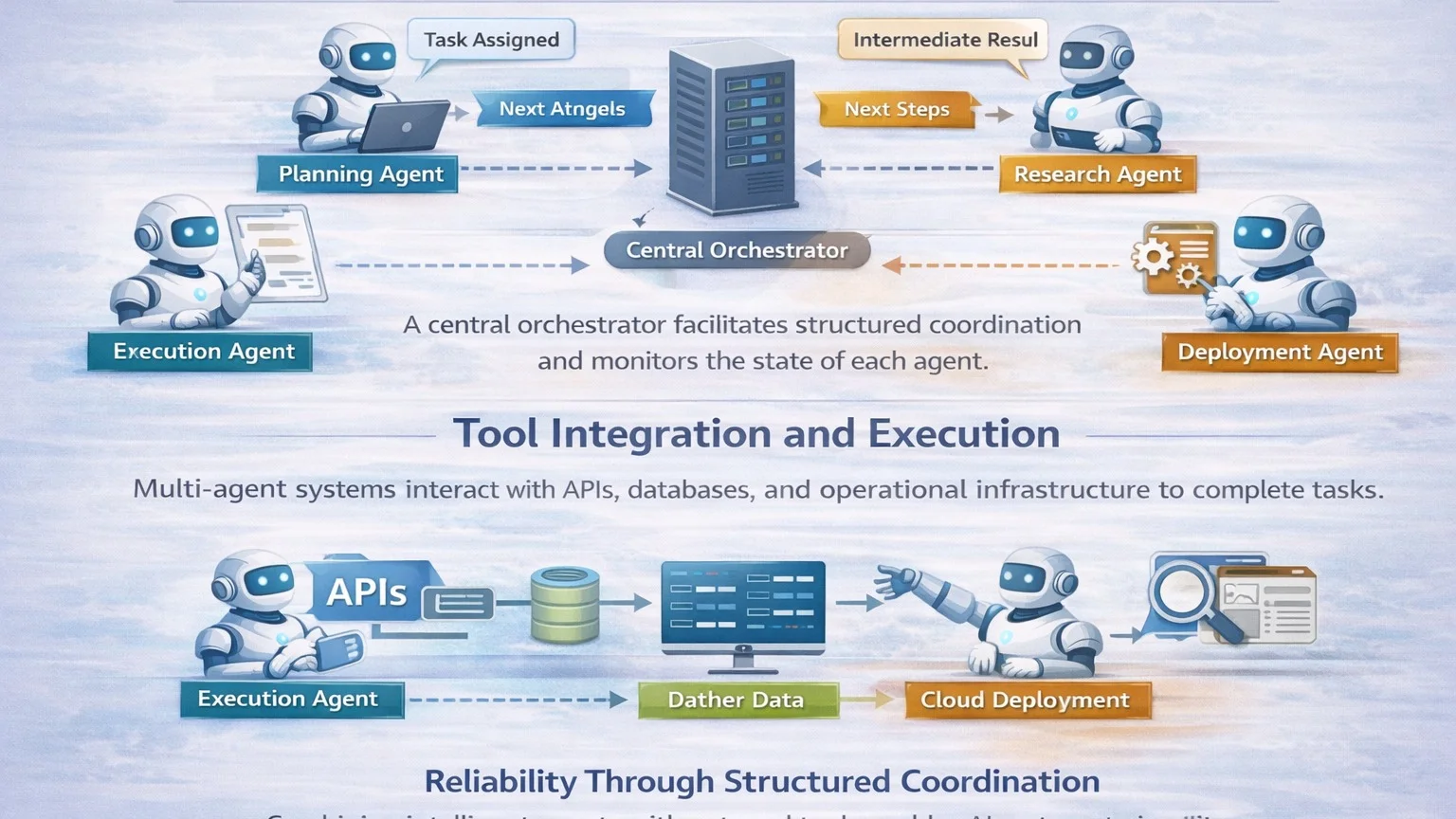
An execution agent may call an API to retrieve data from a database. A deployment agent might trigger a cloud deployment pipeline. Another agent may generate documentation based on the outputs produced earlier in the workflow.
Each of these actions becomes part of the broader multi-agent system.
The agents provide reasoning and coordination, while external tools provide deterministic execution.
This combination enables AI systems to move beyond conversational responses and perform real operational tasks.
Reliability Through Structured Coordination
One of the biggest challenges in AI systems is maintaining reliability when multiple operations occur simultaneously.
Multi-agent architectures improve reliability by introducing structured coordination mechanisms. Each agent focuses on a specific responsibility, reducing the cognitive load placed on any single system.
When combined with validation layers and human oversight checkpoints, this architecture allows AI workflows to operate with greater predictability.
If one agent encounters an error, the orchestrator can pause execution, request clarification, or reroute the task to another agent.
This flexibility makes multi-agent systems more resilient than monolithic AI systems attempting to handle complex tasks alone.
The Future of Collaborative AI Systems
As AI capabilities continue to evolve, multi-agent architectures are becoming increasingly important for building scalable intelligent systems.
Rather than relying on a single powerful model, future AI systems will likely consist of networks of specialized agents working together within structured workflows.
These systems will resemble collaborative teams where each component contributes a specific capability. Planning agents, reasoning agents, tool-execution agents, and monitoring agents will coordinate their actions through orchestration layers.
The result is a distributed intelligence system capable of solving complex problems more effectively than isolated models.
The evolution of AI is therefore not only about building more powerful models.
It is about designing systems where multiple intelligent agents collaborate to perform meaningful work.
Ready to Transform Your Business with AI?
Let's discuss how our AI solutions can help you achieve your goals. Schedule a free consultation with our experts.
Schedule a Consultation