LLM APIs vs Open Source Models: Choosing the Right Approach
Closed APIs like GPT-4 and Claude offer convenience and cutting-edge performance. Open-source models like Llama, Mistral, and Qwen offer control and cost efficiency. This post breaks down the real trade-offs - cost, latency, privacy, customisation, and operational complexity -so you can choose the right approach for your specific use case.


The Decision Every AI Team Faces
At some point in every AI project, someone asks the question: "Should we use an API or run our own model?"
It usually happens after the proof-of-concept works. You've built a prototype using Claude or GPT-4, the demo impressed stakeholders, and now the conversation shifts to production. That's when the real trade-offs surface - cost projections that look different at 10,000 queries per day than they did at 50, data privacy requirements that didn't matter during the demo, latency budgets that an API round-trip can't always meet, and customisation needs that a general-purpose model doesn't quite satisfy.
There's no universally correct answer. The right choice depends on your specific constraints: what you're building, how much data sensitivity is involved, what your team can operate, and where you are on the maturity curve. This post lays out the honest trade-offs so you can make that decision with clarity rather than hype.
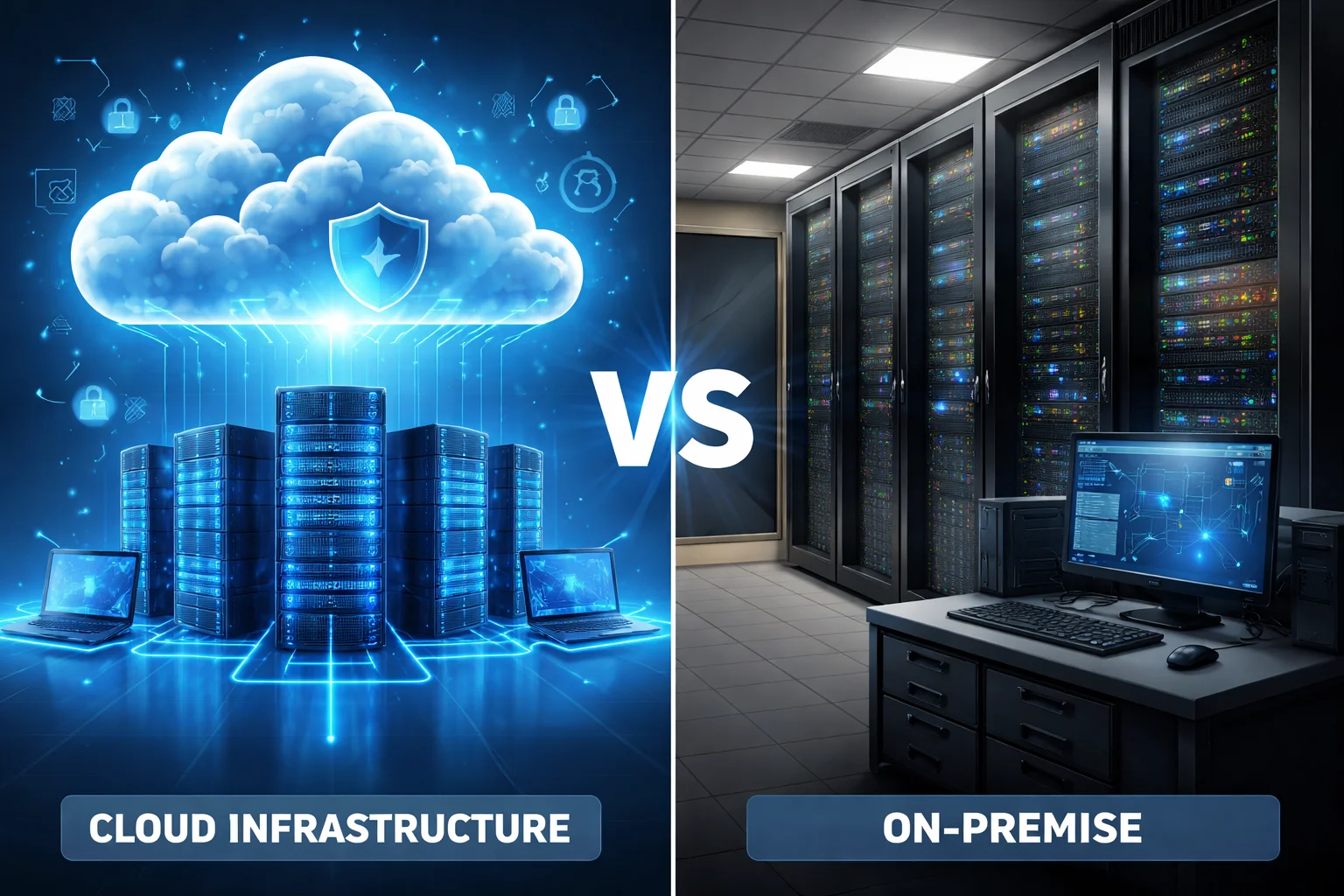
The API vs open-source decision shapes your AI system's cost structure, privacy posture, and operational complexity for years.
The Current Landscape: What's Actually Available
Before diving into trade-offs, let's be clear about what we're comparing. The landscape has shifted dramatically even in the past twelve months.
Closed API Models
These are models you access through a provider's API. You send a request, get a response, and pay per token. You don't see the weights, can't modify the architecture, and depend entirely on the provider's infrastructure.
OpenAI (GPT-4o, GPT-4.5, o1, o3) - The incumbent. Broadest ecosystem, most mature tooling, widest adoption. Pricing ranges from budget-friendly (GPT-4o-mini) to premium (o3 for complex reasoning)
Anthropic (Claude Opus, Sonnet, Haiku) - Known for strong instruction adherence, careful reasoning, and long context handling. Claude Sonnet has become a workhorse for many production systems
Google (Gemini 2.5 Pro, Flash) - Competitive performance, strong multimodal capabilities, deep integration with Google Cloud. The Flash variants offer excellent cost-performance ratios
Amazon (Nova) - Tightly integrated with AWS Bedrock. Appealing for teams already deep in the AWS ecosystem
Open-Source and Open-Weight Models
These are models where the weights are publicly available. You can download them, run them on your own infrastructure, fine-tune them, and modify them without depending on an external provider.
Meta Llama (3.1, 3.3, 4) - The most widely adopted open model family. Available in sizes from 8B to 405B parameters. Strong general-purpose performance, massive community
Mistral (Mistral Large, Small, Nemo) - European-built, strong performance-to-size ratio. Mistral's smaller models punch well above their weight class
Qwen (Qwen 2.5, QwQ) - Alibaba's open models. Particularly strong in multilingual and reasoning tasks. Rapidly closing the gap with frontier models
DeepSeek (V3, R1) - Exceptional reasoning capabilities for their size. DeepSeek-R1 demonstrated that open models can match proprietary reasoning performance
Google Gemma (2, 3) - Lightweight, efficient, designed for on-device and edge deployment
The gap between API models and open models has narrowed significantly. Two years ago, the best open model couldn't match GPT-3.5. Today, the best open models compete with GPT-4 on many benchmarks. That narrowing gap is exactly what makes this decision harder - and more consequential.
The Six Trade-Offs That Actually Matter
Forget the ideological debates about open vs closed. In production, six practical dimensions determine which approach works for your specific situation.

Six dimensions determine the right choice: cost, privacy, latency, customisation, capability, and operational complexity.
1. Cost: The Crossover Point
API pricing is simple - you pay per token. No infrastructure, no GPU procurement, no DevOps overhead. For low-to-moderate volume, this is almost always cheaper.
But API costs scale linearly. If you process 10x more queries, you pay 10x more. Self-hosted models have high fixed costs (GPU hardware or cloud GPU instances) but near-zero marginal cost per query. At some volume, the lines cross.
The rough math:
A single A100 GPU costs approximately $1.50–$2.00/hour on major cloud providers. Running a quantised 70B parameter model on two A100s costs roughly $70–$95/day. That same workload through a frontier API at 1,000 tokens per request might cost $200–$500/day depending on the model and token mix.
The crossover typically happens somewhere between 5,000 and 50,000 queries per day, depending on the specific models being compared, average token lengths, and whether you're using input caching or batch APIs.
But cost isn't just the API bill. Self-hosting requires GPU infrastructure management, model serving frameworks (vLLM, TGI, TensorRT-LLM), monitoring, scaling, failover, and an engineering team that knows how to operate all of it. Those operational costs are real and often underestimated.
The cheapest model isn't the one with the lowest per-token price. It's the one with the lowest total cost of ownership — including the engineering time to keep it running reliably.
2. Data Privacy and Compliance
This is often the deciding factor, and it should be.
When you use an API, your data leaves your infrastructure. The prompts, the context, the user queries - all of it travels to a third party's servers. Most major providers offer data processing agreements, SOC 2 compliance, and commitments not to train on your data. But for some industries and use cases, that's not enough.
Where APIs become problematic:
Healthcare applications processing patient data under HIPAA
Financial services with regulatory restrictions on data residency
Legal applications handling privileged communications
Government and defence applications with classification requirements
Any application where customers contractually require data to stay on-premise
Where APIs are perfectly fine:
Processing publicly available information
Applications where the data is already anonymised
Internal tools where the data sensitivity is low
Prototypes and MVPs where compliance isn't yet a hard requirement
Self-hosted models keep everything within your infrastructure boundary. The data never leaves. For organisations with strict compliance requirements, this alone can make the decision.
3. Latency and Control
API calls introduce network latency - typically 200–800ms of overhead before the model even starts generating tokens. For most applications, this is acceptable. For some, it's not.
Where API latency becomes a problem:
Real-time conversational agents where response time directly impacts user experience
High-frequency processing pipelines where each call adds cumulative latency
Edge applications where network connectivity is unreliable
Multi-step agent workflows where the model is called 5–10 times per user request
Self-hosted models eliminate network latency entirely. The model runs on your infrastructure, often in the same data centre as your application. First-token latency can drop to single-digit milliseconds.
Beyond latency, self-hosting gives you operational control that APIs can't match. You control the batch size, the inference engine, the hardware allocation, the scaling behaviour, and the priority queuing. You're never surprised by a provider's rate limit, outage, or deprecation notice.
4. Customisation and Fine-Tuning
This is where open models pull decisively ahead - if you need it.
API models offer limited customisation. OpenAI and Anthropic provide fine-tuning on some models, but you're constrained to their supported formats, limited in how much you can alter behaviour, and dependent on their fine-tuning infrastructure.
Open models offer full control:
Fine-tuning — Adjust the model's behaviour on your specific domain data. A legal AI trained on your firm's case history. A medical assistant tuned on your clinical guidelines. A customer support agent that matches your brand voice precisely
LoRA and QLoRA - Parameter-efficient fine-tuning methods that let you customise large models with modest GPU resources. You can fine-tune a 70B model on a single A100 in hours
RLHF and DPO - Align the model's outputs with your specific quality criteria using human feedback
Architecture modifications - Add custom attention mechanisms, modify tokenisers for domain-specific vocabulary, implement speculative decoding for faster inference
Quantisation control - Choose exactly how to compress the model - 4-bit, 8-bit, mixed precision - balancing quality against speed and memory for your specific use case
The honest caveat: Most teams don't need this level of customisation. For 80% of use cases, a well-prompted API model with good RAG does the job. Fine-tuning is expensive, requires expertise, and introduces a maintenance burden (your fine-tuned model doesn't automatically benefit from the provider's improvements). Only invest in fine-tuning when prompting and RAG demonstrably aren't enough.
Open models offer full control over fine-tuning, quantisation, and architecture - but most teams overestimate how much customisation they actually need.
5. Capability and Intelligence
Let's be direct: frontier API models are still the smartest models available.
Claude Opus, GPT-4.5, Gemini 2.5 Pro, and o3 consistently outperform open models on the hardest benchmarks - complex multi-step reasoning, nuanced instruction following, sophisticated code generation, and tasks requiring broad world knowledge.
Open models have closed the gap dramatically. Llama 4 Maverick, DeepSeek-R1, and Qwen 2.5 72B are genuinely impressive. For many production tasks - classification, extraction, summarisation, straightforward Q&A - the performance difference is negligible.
But the gap still matters for:
Complex agentic workflows where the model needs to plan, reason, and self-correct across many steps
Tasks requiring deep understanding of ambiguous instructions
Creative and nuanced writing where subtle quality differences compound
Safety-critical applications where even small error rate differences have outsized consequences
The practical question isn't "which is smarter?" - it's "is the open model smart enough for this specific task?" If the answer is yes, the other advantages of self-hosting may tip the balance. If the answer is no, no amount of cost savings justifies worse outcomes.
6. Operational Complexity
This is the trade-off that catches teams off guard.
Using an API means:
Zero infrastructure management
Automatic scaling to handle traffic spikes
No GPU procurement or capacity planning
No model serving, monitoring, or optimization to manage
Upgrades happen automatically (for better or worse)
Your engineering team focuses on the application, not the model
Self-hosting means:
GPU infrastructure provisioning and management
Model serving frameworks (vLLM, Text Generation Inference, TensorRT-LLM)
Load balancing and auto-scaling configuration
Health monitoring, alerting, and incident response
Model updates, security patches, and performance optimization
A team with ML infrastructure expertise — which is hard to hire
The most common failure mode I see: a team self-hosts to save money on API costs, then spends more on ML infrastructure engineering than they saved. Know your team's capabilities honestly before committing to self-hosting.
The Hybrid Approach: Why Most Production Systems Use Both
Here's what the binary framing misses: you don't have to choose one. The most effective production systems I've seen use both API and open-source models, routing different tasks to different models based on the task requirements.
A typical hybrid architecture looks like this:
Frontier API model for the hardest tasks — complex reasoning, agentic workflows, safety-critical decisions. These are the queries where intelligence matters most and volume is lower
Self-hosted mid-size open model (7B–70B) for high-volume, well-defined tasks — classification, extraction, summarisation, embedding generation. These are the queries where cost per token matters most
Small specialised model (1B–7B) for latency-critical or edge tasks — real-time intent detection, input validation, simple routing decisions
This approach gives you the intelligence of frontier models where you need it and the cost efficiency of open models where you don't. The router — which can itself be a small, fast model — directs each query to the appropriate model based on complexity, latency requirements, and cost constraints.
The practical benefit: Your API bill drops by 60–80% because the expensive model only handles the queries that genuinely need it. Your latency improves because simple queries get fast local responses. Your privacy posture improves because sensitive data routes to self-hosted models while general queries use APIs.
A Decision Framework: Matching Approach to Use Case
Rather than prescribing a universal answer, here's how to think through the decision for your specific situation:
Start with APIs when:
You're building an MVP or prototype and need to move fast
Your query volume is under 5,000/day and cost isn't yet a pressure point
Your team doesn't have ML infrastructure expertise
Data privacy requirements can be met with standard DPAs
You need frontier-level intelligence for your core use case
Time to production matters more than long-term cost optimization
Add self-hosted models when:
Query volume crosses the cost crossover point for your workload
Regulatory or contractual requirements mandate on-premise data processing
Latency requirements can't be met with API round-trips
You've identified specific tasks where a fine-tuned smaller model outperforms prompting
You have (or can hire) ML infrastructure engineering capability
You need guaranteed availability independent of third-party providers
Go fully self-hosted when:
All data must remain within your infrastructure boundary — no exceptions
You're operating at massive scale where API costs are prohibitive
You need deep model customization that APIs can't support
You have a mature ML platform team that can operate inference infrastructure reliably
You're building a product where model control is a core competitive advantage

The most effective production systems use both - routing queries to the right model based on complexity, cost, and privacy requirements.
What Changes in the Next Twelve Months
This decision won't get easier. Several trends are actively reshaping the landscape:
Open models keep getting better. Each new Llama, Mistral, and Qwen release narrows the gap further. Tasks that required GPT-4 a year ago can now be handled by a 70B open model at a fraction of the cost.
Inference costs keep dropping. Both API prices and GPU costs are falling. The crossover point shifts, but so do the absolute economics. What costs $500/day today might cost $100/day in a year — on either approach.
Hybrid routing gets smarter. Frameworks for intelligent model routing are maturing rapidly. The overhead of running a hybrid system is decreasing, making it accessible to smaller teams.
Edge deployment becomes viable. Models like Gemma 3, Phi-4, and quantised Llama variants run on consumer hardware. Use cases that required cloud infrastructure are moving to laptops, phones, and edge devices.
Regulation tightens. The EU AI Act, evolving data residency laws, and sector-specific regulations are pushing more organisations toward self-hosted models, regardless of whether the economics favour it.
Conclusion: Choose Based on Constraints, Not Convictions
The worst way to make this decision is ideologically. "Open source is always better" and "just use the API" are both positions that ignore context. The best approach is to list your actual constraints - budget, privacy, latency, intelligence requirements, team capability, regulatory environment - and let those constraints guide you to the right architecture.
For most teams starting today, the pragmatic path is: begin with APIs, measure your actual requirements in production, and introduce self-hosted models for specific workloads where they offer a clear advantage. Don't over-engineer the infrastructure before you've validated the product.
The teams that do this well aren't the ones who picked the "right" model on day one. They're the ones who built systems flexible enough to route to the right model for each task - and disciplined enough to let evidence, not assumptions, drive the decision.
Ready to Transform Your Business with AI?
Let's discuss how our AI solutions can help you achieve your goals. Schedule a free consultation with our experts.
Schedule a Consultation