The New AI Developer Stack in 2026
The way developers build software has changed. This guide breaks down the AI developer stack in 2026 — from LLMs and agents to orchestration, memory, deployment, and observability.

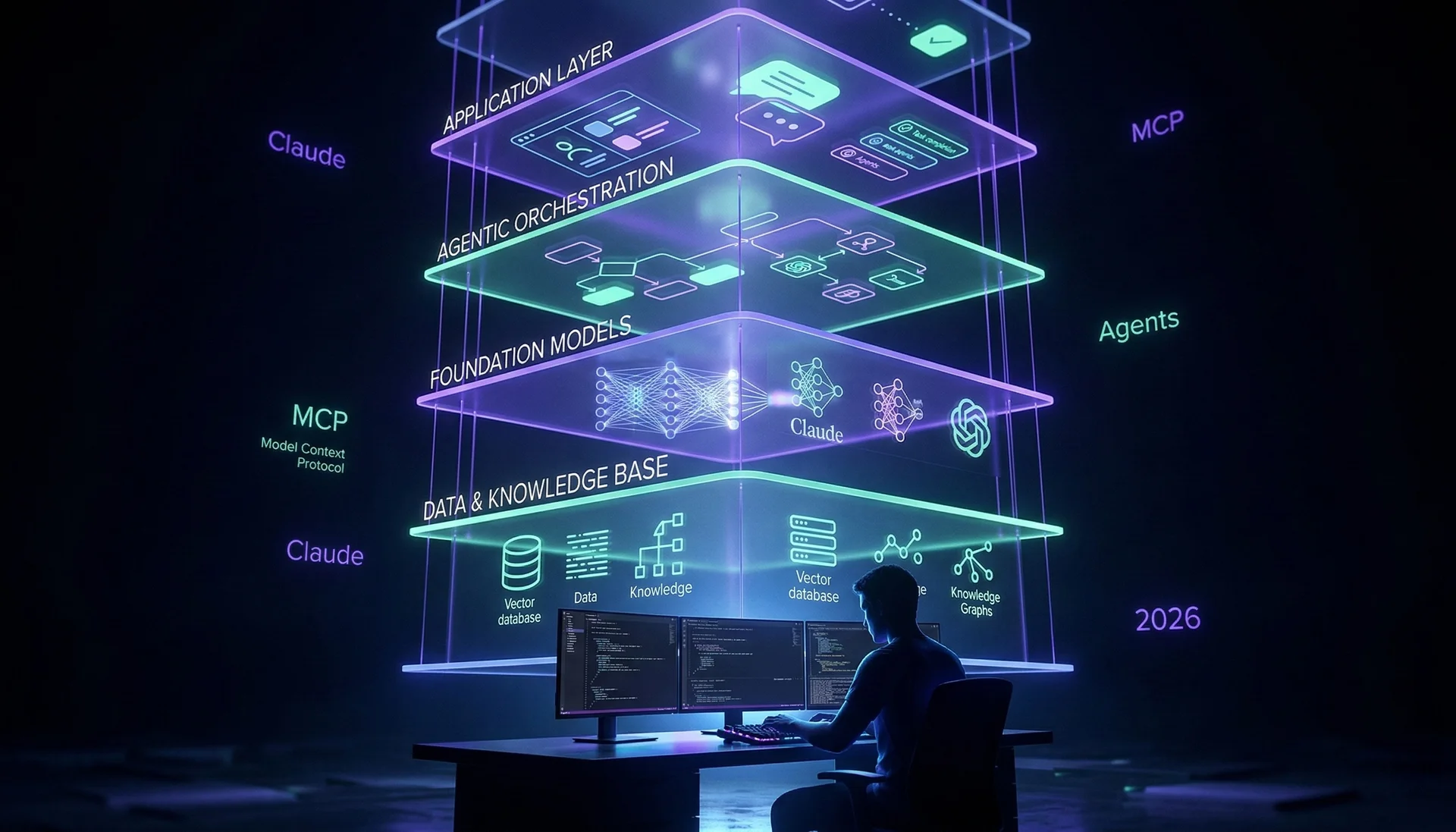
How modern developers are building AI-powered software today
Two years ago, “using AI” mostly meant copying code into ChatGPT and hoping it worked.
Today, AI is embedded in every stage of software development — from writing code and reviewing pull requests to deploying production systems and monitoring outputs.
The modern developer stack has changed completely.
If you are still building software the same way you did in 2023, you are already behind.
This article breaks down the AI developer stack in 2026 — the tools, layers, and architecture shaping how modern software is built.
The AI Developer Stack
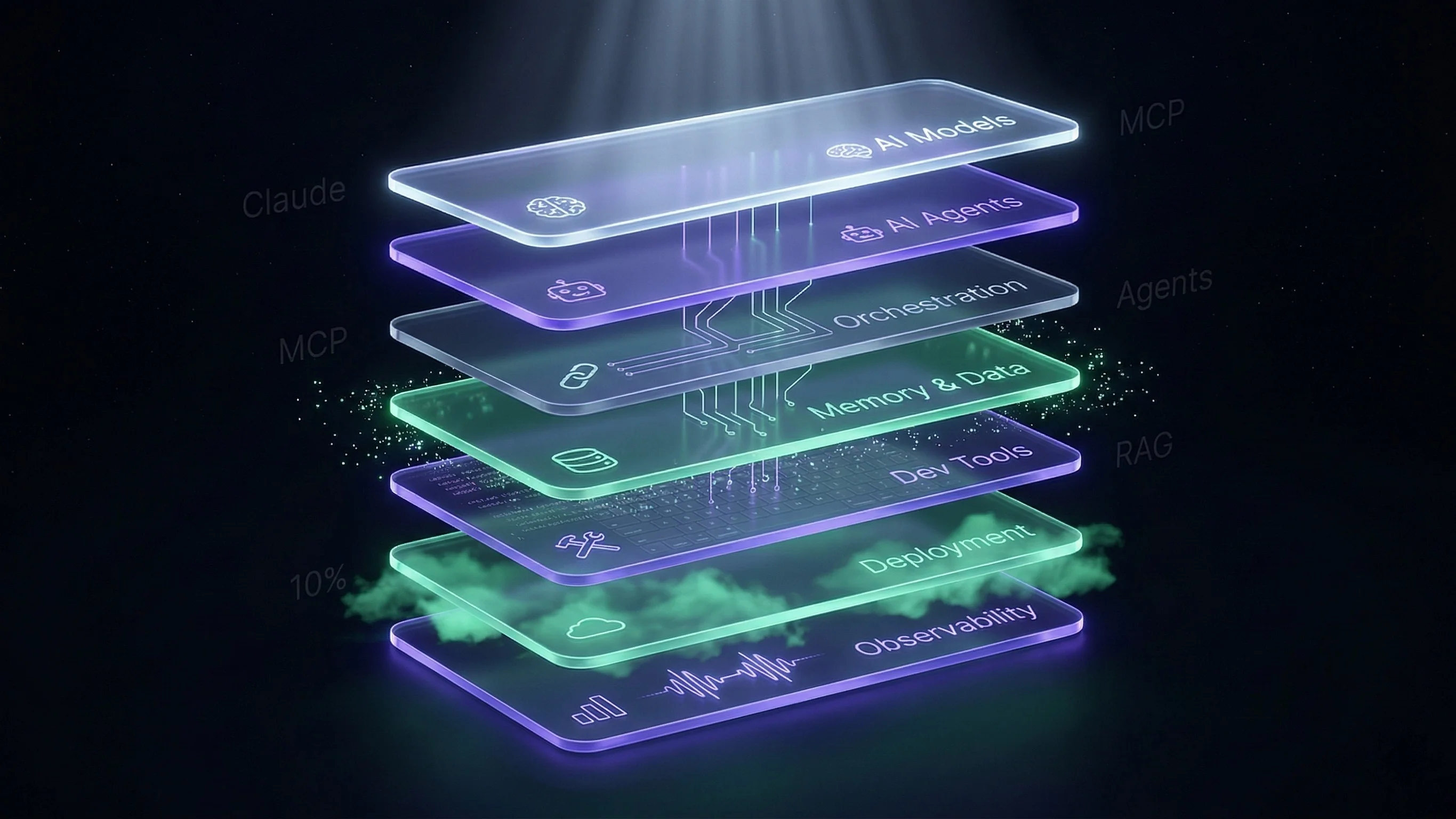
The modern AI development ecosystem is composed of seven key layers. Each layer plays a specific role in building scalable AI applications.
The stack looks like this:
AI Models
AI Agents
Orchestration
Memory & Data
Developer Tools
Deployment
Observability
Together, these layers form the foundation of modern AI-powered applications.
1. The Model Layer: The Brain of AI Systems
At the core of every AI system is a large language model (LLM).
In 2026, choosing the right model is as important as choosing your programming language.
Different models specialize in different capabilities.
Major frontier models
Claude (Anthropic)
Best for reasoning, coding, long context analysis.
GPT-4o (OpenAI)
Strong for multimodal tasks and general AI workflows.
Gemini (Google)
Optimized for search integration and large-scale context.
Llama (Meta)
Best choice for self-hosted or private deployments.
Important shift
Smart engineering teams do not rely on one model anymore.
Instead they route tasks between models:
Cheap model → simple tasks
Powerful model → reasoning tasks
This reduces AI infrastructure costs by 60–80%.

2. AI Agents: From Assistants to Autonomous Systems
One of the biggest shifts in AI development is the move from assistants to agents.
Assistants simply answer questions.
Agents perform tasks.
An AI agent can:
Read and modify files
Call APIs
Run code
Search the internet
Execute multi-step workflows
Instead of answering a prompt, the agent works toward a goal.
Popular agent tools
Claude Code
A terminal-based coding agent capable of understanding entire repositories.
Cursor
An AI-native IDE widely used by developers.
Devin
A highly autonomous AI software engineer capable of handling full tasks.
OpenAI Agents SDK
A framework for building custom AI agent workflows.
Agents represent the transition from AI assistance → AI automation.
3. Orchestration: Connecting AI Systems Together
A single AI model is powerful.
But the real power comes when multiple systems work together.
Orchestration tools manage connections between:
models
APIs
databases
external services
tools
This allows developers to build complex AI workflows.
Key orchestration frameworks
LangGraph
Graph-based workflows for building advanced agent pipelines.
CrewAI
Framework for multi-agent collaboration.
AutoGen
Microsoft's system for multi-agent conversational AI.
Model Context Protocol (MCP)
A major breakthrough is MCP (Model Context Protocol).
It allows AI models to interact with external tools through a standard interface.
You can think of MCP as:
HTTP for AI tools.
It enables models to access:
GitHub
Databases
APIs
calendars
development environments
without custom integrations.
4. Memory and Data: Giving AI Systems Knowledge
LLMs do not naturally remember information.
Every interaction normally starts from scratch.
To solve this, modern AI systems use Retrieval Augmented Generation (RAG).
RAG works by:
Storing information in a database
Retrieving relevant information during a prompt
Feeding that information into the model
This allows AI to work with real company data.
Common memory tools
Pinecone
Production-grade vector database.
pgvector
Vector search inside PostgreSQL.
Weaviate
Open-source vector database for large-scale search.
Mem0
An emerging tool for persistent agent memory.
This layer turns AI from a generic chatbot into a knowledge system.
5. Developer Tools: AI-Native Coding Environments
Traditional code editors are evolving into AI-native development environments.
Instead of autocompleting code, modern tools:
understand your entire codebase
generate multi-file changes
write tests automatically
refactor large projects
explain legacy code
Developers now work with AI as a pair programmer.
Popular AI development tools
Cursor
AI-native IDE with deep repository awareness.
GitHub Copilot
Integrated AI assistance across development workflows.
Windsurf
Fast emerging AI development environment.
Zed AI
High-performance editor with integrated AI collaboration.
Developers using these tools report productivity increases of 40–60%.
6. Deployment: Shipping AI Applications
Deploying AI systems introduces new challenges compared to traditional apps.
AI systems must handle:
streaming responses
high latency
unpredictable costs
prompt versioning
model routing
New platforms are emerging to simplify AI deployments.
Popular deployment tools
Vercel AI SDK
Simplifies building streaming AI interfaces.
Modal
Run Python functions on GPUs with minimal infrastructure.
Replicate
Deploy open-source models through APIs.
These tools help teams move AI applications into production faster.
7. Observability: Monitoring AI Systems
AI systems behave differently from traditional software.
They can produce:
hallucinations
inconsistent responses
unexpected costs
reasoning failures
Without monitoring, it becomes impossible to debug these issues.
This created the need for AI observability platforms.
Observability tools
LangSmith
Tracing and evaluation platform for LLM applications.
Helicone
AI usage monitoring and cost tracking.
Braintrust
Evaluation system for testing AI outputs.
Arize AI
Enterprise-grade AI monitoring platform.
These tools track:
latency
cost
prompt traces
output quality
Observability turns experimental AI systems into reliable production infrastructure.
Why This Stack Matters
We are at a similar moment to:
cloud computing in 2010
mobile apps in 2012
containers in 2016
Developers who adopt the AI stack early will shape the next generation of software.
AI does not remove developers.
It amplifies the developers who know how to use it well.
The future of software engineering is shifting from:
writing every line of code → designing intelligent systems that execute tasks.
Final Thoughts
The AI developer stack will continue evolving.
New tools will appear.
Some existing tools will disappear.
But the key skill remains the same:
Learning how to integrate AI tools quickly into real systems.
Developers who master this skill will build faster, ship better products, and stay ahead in the rapidly changing world of AI.
Ready to Transform Your Business with AI?
Let's discuss how our AI solutions can help you achieve your goals. Schedule a free consultation with our experts.
Schedule a Consultation